
Why Phoenix Housing Forecasts Matter in 2026
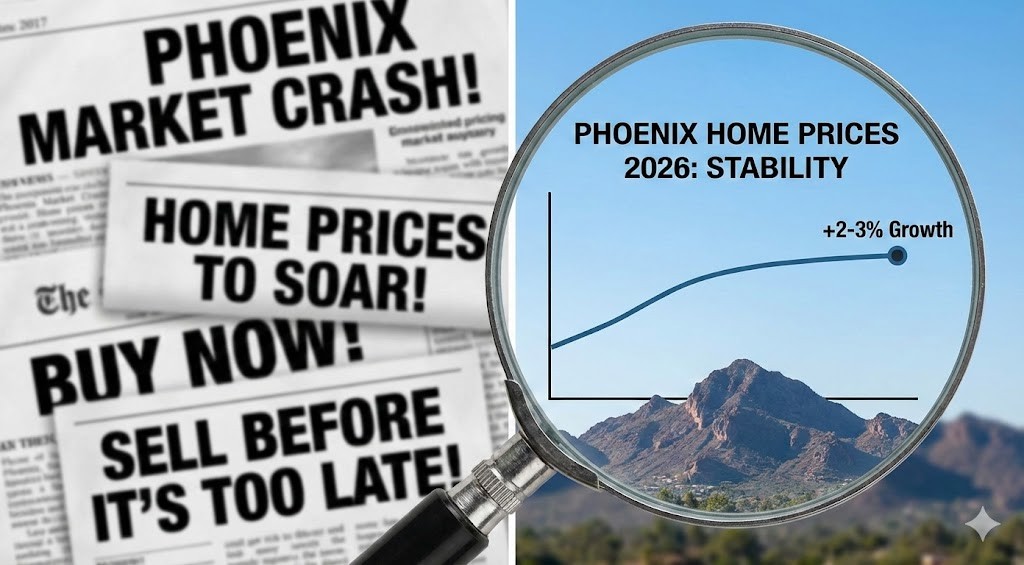
If you’ve been watching the headlines lately, you might feel like you’re getting mixed signals. Some sources scream about a crash, while others promise a boom. As a Phoenix-based REALTOR® who looks at the data every day, I know that for homeowners in the Valley, uncertainty is the enemy of good decisions.
If you have owned a home for more than a few years, you likely have significant equity, but you’re also seeing “For Sale” signs sit a little longer than they used to. You want to know if 2026 is the year to cash out or if waiting will cost you. Understanding the forecast isn’t just about curiosity; it’s about risk management. The shift we confirmed in November 2025 toward a Buyer’s Market means the “list it and they will come” strategy is dead. To win in 2026, we need to rely on hard numbers, not hope.
Where Phoenix Home Prices Stand Today
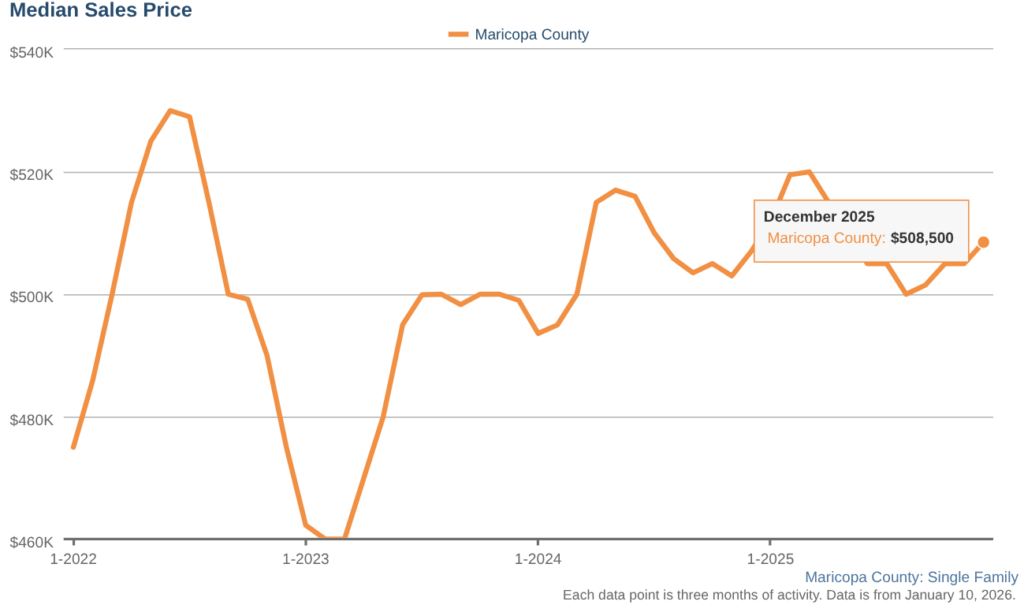
Before we look ahead, it’s important to understand where the market is right now. Data from the Arizona Regional Multiple Listing Service (ARMLS) shows that the 3-month moving median resale single-family home price in Maricopa County was $508,500 in December 2025, up only slightly from about $507,000 a year earlier.
In plain English: home values are holding steady, not surging or slipping.
That stability matters because this metric smooths out seasonal swings and short-term noise. While individual months may tick up or down, the broader trend shows that prices have largely leveled off despite higher mortgage rates.
This tells us the Phoenix market has shifted away from rapid appreciation and into a more balanced phase—where pricing is supported by fundamentals, not momentum.
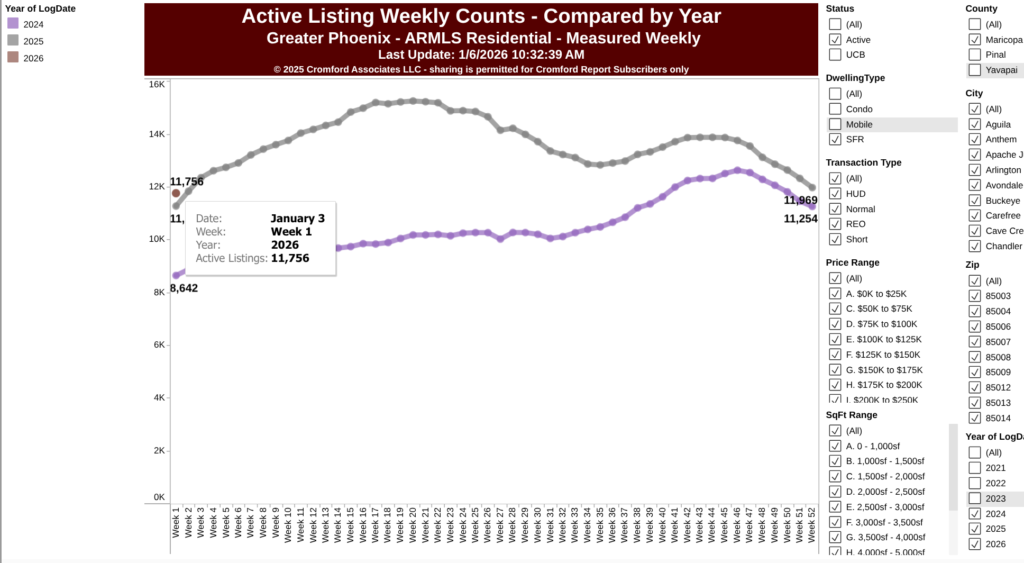
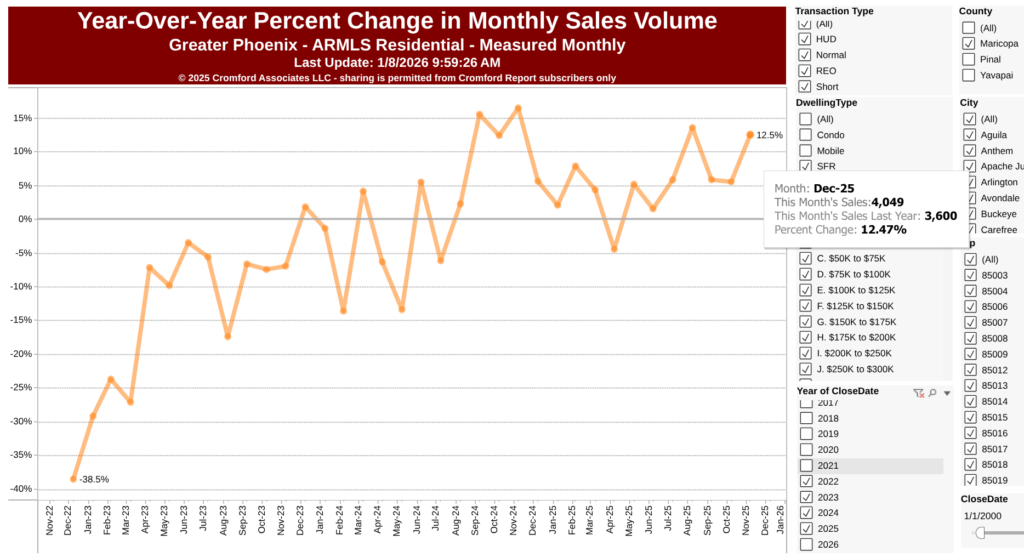
However, headline prices don’t tell the full story. According to the Cromford Report—the gold standard for Greater Phoenix market data—closed sales finished higher YoY, while pending sales softened and inventory increased, which is why buyers are seeing more negotiating room and choice than during the post-pandemic lows.
This combination—steady demand alongside higher available supply—defines today’s market. It’s no longer the one-sided seller environment of 2021–2022, but it’s also not a stalled market. Buyers have more negotiating leverage on pricing and terms, while sellers who price correctly are still seeing homes move.
What the Major Forecasting Sources Are Saying
When looking at national forecasts, it’s critical to remember that real estate is hyper-local. A national average doesn’t always reflect what’s happening in North Phoenix or Scottsdale. However, these major models give us the economic guardrails we need to plan.
Zillow’s 2026 Housing Market Outlook (Phoenix Context)
While Zillow’s specific 2026 granular data for Phoenix is often adjusted short-term, their broader outlook suggests a stabilization period. The days of double-digit appreciation are largely behind us for this cycle. The general expectation is for a flattening curve—where prices don’t necessarily drop significantly, but growth is muted.
Realtor.com & National Association of REALTORS® Forecasts
Realtor.com’s 2026 national housing forecast expects modest home price growth of about 2.2% along with a slight uptick in existing-home sales of about 1.7%, which reflects a stabilizing housing market with slow, steady gains.
For Phoenix, this aligns with what we call a “normalization.” National Association of REALTORS® Chief Economist Lawrence Yun has also described price growth in 2026 as moderate and low-single digits (roughly 2–3%), in line with broader inflation, suggesting prices will continue to rise but not at the dramatic rates seen earlier in the cycle. This means your home’s value is preserved, but it’s not an aggressive wealth-generating asset in the short term like it was in 2021.
Fannie Mae, MBA, and National Economic Models
The Mortgage Bankers Association projects that 30-year mortgage rates will likely stay in a relatively narrow band around 6%–6.5% through 2026, which could give buyers more confidence in planning budgets.
Fannie Mae’s Home Price Expectations Survey suggests national home price growth in 2026 will be modest, with some expert panel scenarios near 2.1%, showing a significant slowdown from earlier pandemic-era gains.
Taken together with other major housing forecasts, this points toward a more stable, low-growth market environment in 2026 compared with the volatility of prior years — a healthier backdrop for buyers and sellers than extreme ups and downs.
Is a 14% Price Increase Forecast for Phoenix Accurate?
You may have heard rumors or clickbait headlines about a 14% increase in home prices in 2026. Let me be clear: no major housing forecast supports a 14% home price appreciation for 2026 — that figure is tied to expected growth in home sales volume, not price growth.
According to the National Association of REALTORS® and other leading forecasters (Realtor.com, Fannie Mae, Zillow, MBA), home price growth in 2026 is projected to be modest — generally in the low single digits nationally.
That’s consistent with current inventory and affordability trends: prices are expected to grow at a more sustainable pace rather than in the double digits, even as sales activity increases.
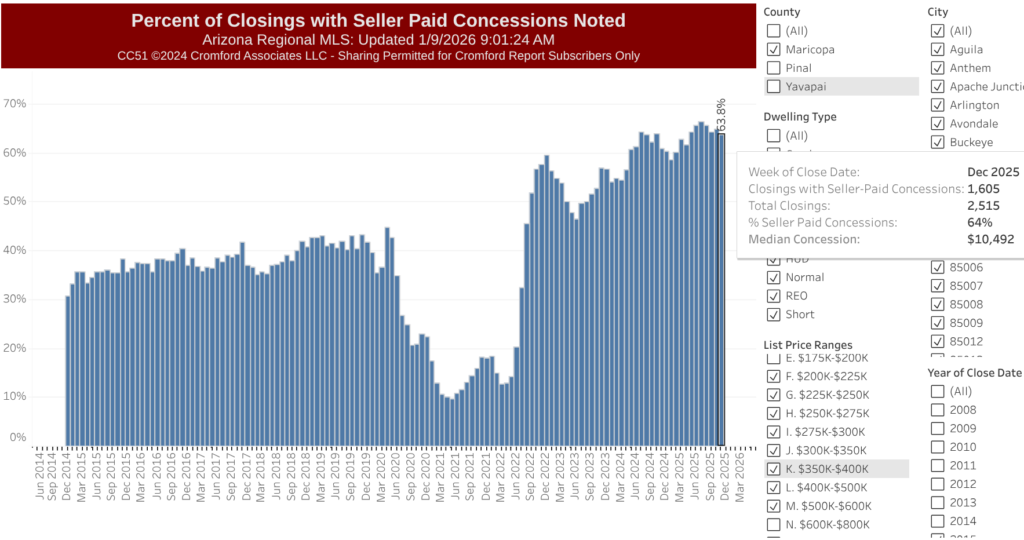
Given our current supply levels and the affordability ceiling for many Valley buyers, a double-digit price jump is mathematically unlikely. We are seeing concessions in more than half of transactions between $200,000 and $600,000. That behavior does not happen in a market poised for a 14% price spike.
Realistic Phoenix Home Price Expectations for 2026
So, what should you actually expect? Based on the convergence of local Cromford Report data and national economic models, realistic expectations for Phoenix in 2026 are:
- Low-to-Mid Single Digit Growth: Expect appreciation in the 0% to 3% range.
- Flatlining in Some Areas: Some neighborhoods, particularly those that saw the steepest run-ups, may see prices stay effectively flat.
- A Stable, Predictable Market: Minimal volatility, with prices and activity remaining steady across most neighborhoods.
This isn’t bad news. It means stability. It means we aren’t facing a crash, but we also can’t overprice a home and expect the market to catch up to us.
What This Forecast Means for Phoenix Buyers
If you are looking to buy, 2026 is shaping up to be an opportunity year, provided you are strategic.
- Negotiation Power: With the Cromford Market Index (CMI) hovering around the 80s (indicating more a Buyer’s Market), you have leverage. You can ask for repairs, closing costs, or rate buydowns.
- Inventory Choices: Unlike the shortage years, you will likely have multiple homes to choose from, especially if you are looking in the West or Southeast Valley, where growth is concentrated.
- Rate Reality: Don’t wait for 3% rates to return, that is most likely a once-in-a-lifetime scenario. If you can afford the monthly payment at 6.3%, you can secure a home now without the bidding wars of the past.
What This Forecast Means for Phoenix Sellers
For my sellers, particularly those with high equity looking to move up, this forecast requires a shift in strategy.
- Precision Pricing: You cannot “test the market” with a high price in 2026. With inventory rising (Realtor.com predicts a nearly 9% increase in inventory nationally), an overpriced home will simply sit.
- Marketing Matters: Since 91% of successful sales involve an agent, who you hire matters more than ever. You need differentiation. Staging, professional photography, and strategic exposure are non-negotiable.
- Concessions: Be prepared to offer concessions. It’s a standard tool in today’s transaction to help buyers with rate buydowns. It’s often cheaper to offer a concession than to drop the list price.
Phoenix Is Not One Market: Submarket Variations to Watch
The “Phoenix Metro” average can be misleading because our valley is huge. We are seeing distinct differences based on geography and price point.
- TSMC Impact (North Phoenix): Areas surrounding the Taiwan Semiconductor Manufacturing Co. plant are likely to outperform the average due to job growth and housing demand from incoming workers.
- Luxury vs. Entry-Level: The Cromford Report notes that segments under $1 million have softened roughly 2-3%, while mid-tier neighborhoods are down further from peaks. However, luxury pockets often behave independently of interest rates.
- Rental Competition: With nearly 29,000 build-to-rent units in the pipeline, landlords and investors need to be aware that rental supply is heavy, which could cap rent growth.
How I Interpret These Forecasts as a Phoenix Realtor
As I analyze this data for my clients, my takeaway is cautious optimism rooted in fundamentals. We are not in a freefall. We are in a correction to the mean—a return to normal.
The “lock-in” effect is real; many of you have rates below 4% and don’t want to sell. However, life events—marriages, jobs, upsizing—don’t stop for interest rates.
My job is to help you navigate the gap between “what I want for my home” and “what the data says it will sell for.” In 2026, the winners will be the sellers who prepare their homes impeccably and price them based on the most recent comparable sales, not the sales from six months ago. We have to be agile. If we see active listings spike in your specific subdivision, we need to react fast.
Frequently Asked Questions About the Phoenix Housing Market in 2026
Will Phoenix home prices drop in 2026?
Broadly speaking, a massive drop is not forecasted. We expect prices to remain flat or grow very slightly (around 2%). However, real, inflation-adjusted home prices might decline slightly as inflation outpaces appreciation.
Is now a good time to buy in Phoenix?
Yes, if you value choice and negotiation. The current buyer demand-to-supply index suggests you have the upper hand regarding terms and repairs, which was impossible a few years ago.
Are sellers still negotiating in Phoenix?
Absolutely. With inventory rising and pending sales softening, sellers who want to move are negotiating. Concessions are becoming the norm, not the exception.
Talk With a Phoenix Realtor Who Tracks the Data Closely
Navigating a changing market requires more than just reading headlines; it requires an advocate who understands the nuances of your specific neighborhood. Whether you are in 85032, looking along the SR51 corridor, or eyeing new construction in the West Valley, I’m here to help you make sense of the numbers.
If you have questions about your specific home’s value in this 2026 forecast, holler with any questions, comments, or concerns.
Jeffrey Daniels, REALTOR®
Phoenix Metro Real Estate Specialist